What is a Future Reality Tree?
In this post, we will explain what a Future Reality Tree is and how you can use it to help you make improvements in complex environments.
If you’ve not already read our post on Current Reality Trees you may want to read that first as it’s essential to identify root causes before you build your Future Reality Tree.
What is a Future Reality Tree?
The Future Reality Tree (FRT) is a tool from the Theory of Constraints (TOC) Thinking Processes and it can help us to map out the cause and effect of your proposed changes through a system.
By visualising all the connections, you can see whether your idea really solves the problems you found, and importantly, whether it might create any new problems.
In simple terms, the Future Reality Tree is a predictive tool.
While the Current Reality Tree describes what’s happening today, the Future Reality Tree models what could happen if we act. It’s about testing the logic of your solution before you spend time, money, and effort implementing it.”
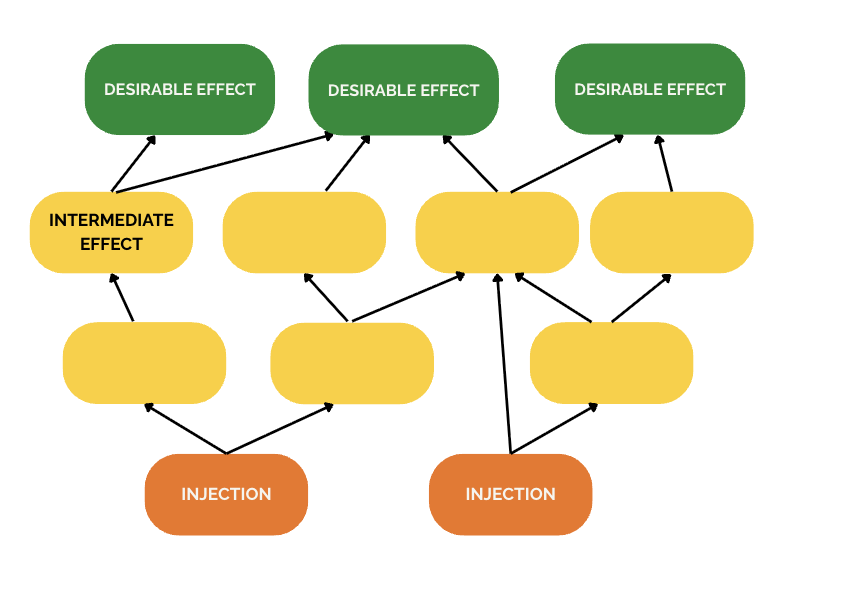
In this picture you can see a simplified diagram of a Future Reality Tree. You will notice that the shape of the tree is very similar to that of a CRT.
At the bottom instead of root causes you have injections. These are the improvements you are planning on making to address the root causes.
Similar to a CRT you have several layers of intermediate effects, then at the top of the tree you have desirable effects, which are the positive outcomes you want to achieve.
Similar to a CRT, each arrow shows a cause-and-effect link. As you go up the tree, you can see the potential impact that each change has.
What is an Injection?
William Dettmer, the author of The Logical Thinking Process describes an injection as follows:
“An injection is a new condition or action that does not exist in the current reality. It is something you must make happen in order for the future reality to unfold the way you want it to”
Think of it this way: a root cause is something you discover, an injection is something you create. For example: saying ‘we buy new running shoes’ is not really an injection. Saying ‘we establish a routine of exercising three times a week’ is, because it changes the conditions of reality.

Building your Future Reality Tree
There are two main ways to build a Future Reality Tree.
The first is to start with your injections and work your way up, mapping out the cause-and-effect steps that lead to the desirable outcomes.
The second is to take your Current Reality Tree and reverse every statement, essentially flipping it from describing what’s wrong now, to describing how things could look if the problems were solved.
Either way, the goal is the same: to test whether your logic holds up, and whether your proposed changes will really get you to the results you want.
Negative Branches
Of course, sometimes a change brings with it unintended side effects. In a Future Reality Tree, that’s shown as a negative branch, where an injection accidentally creates a new Undesirable Effect.
So what can you do? There are three options:
- Don’t go ahead with that injection.
- Go ahead and live with the consequences, if they’re minor.
- Or the best option trim the negative branch by adding another injection to eliminate the problem.
For example: new software might speed up processing times (great!), but it also overwhelms your support team with extra queries (not so great). You could trim that branch by adding training or more support resources.
So to sum up, the Future Reality Tree helps you design solutions with confidence. It takes your injections, the changes you want to make and logically maps them through to the outcomes you’re aiming for.
Along the way, it helps you spot risks, test assumptions, and deal with negative branches before they derail you.
If you’d like to learn more about how to use Current and Future Reality Trees click here to access our online video TOC course or get in touch for a free consultation call.