
The Ultimate Product Roadmap Guide – A Practical Deep Dive
“That’s not on the Roadmap!”
It’s that trusty tool we all turn to, especially when we need to push back with the five magic words above.
In this deep dive, we will explore what a product roadmap is, how to create one collaboratively, common pitfalls that lead to failure, and practical steps to set your roadmap up for success. We’ll also share a product roadmap template and example, which you can download (subscribe to our newsletter to get the templates, if you’ve not already done so).
- What is a product roadmap?
- Product Roadmap Tools and Formats
- Showing Outcomes and Metrics on your Roadmap
- Vision, Strategy, Roadmap, Plan, Backlog – What’s the Difference?
- Facilitating a Product Roadmap Session
- Why Roadmaps Fail
- Next Steps for your Product Roadmap
What is a Product Roadmap Exactly?
At its core, a roadmap communicates your strategic direction, helping you bring your vision to life. It’s more than just a planning tool, it’s a way to align and visualise where your product, team, or organisation is headed. It keeps your teams, company, and stakeholders on the same page, ensuring everyone is aligned on the journey ahead.
Think of your roadmap as a shared, single source of truth.
Your guide to ensuring everyone is travelling down the same road.
However, a great roadmap isn’t created in isolation. It’s co-created with the customer in mind, shaping the future direction of your product or service.
In a nutshell, a product roadmap tells the story of where you’re headed and how you’ll reach your vision.
While roadmaps are traditionally used for products, we’ve also found them extremely effective for team growth and individual development journeys. They serve as a versatile tool for visualising progress and setting strategic goals, whether it’s for a product or personal growth.

Product Roadmap Tools and Formats
There are so many product roadmap tools and templates out there that it can be overwhelming and it is easy to spend too much time looking for the perfect format rather than just getting started.
For teams new to product roadmaps, it’s hard enough to grasp the concepts, they don’t need to be overwhelmed with a overly complicated template.
A good product roadmap as a minimum should contain the outcomes that you want to achieve and metrics that you want to measure your success.
We love the Now, Next, Later roadmap format invented by Janna Bastow, as it is simple to create, easy to understand and is not overwhelming. It provides a flexible way to visualise your product’s priorities over time.
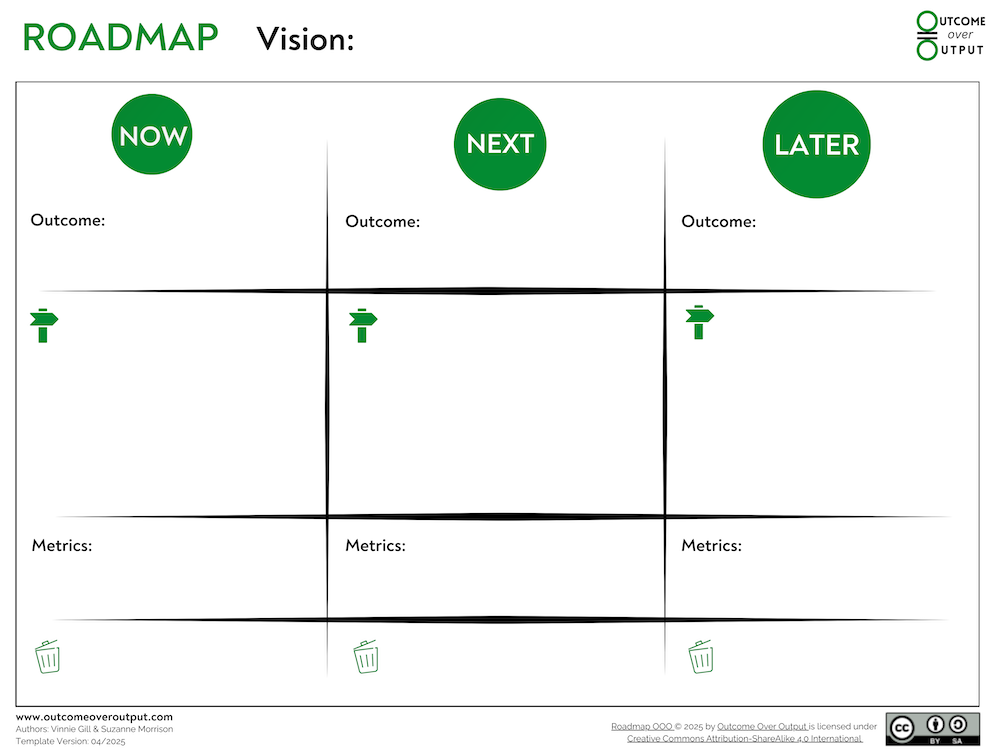
It focuses on high-level outcomes, grouped into Now (what’s in progress), Next (what’s coming soon), and Later (future opportunities with less detail).
This approach helps to keep teams aligned whilst avoiding the common pitfall of people fixating on specific dates far into the future. It also allows for flexibility as priorities evolve.
If you’re not already subscribed to our newsletter, subscribe below for free and download our product roadmap template and example.
During product roadmap review sessions we like to ask and encourage teams to delete what isn’t working. Having a delete section in your roadmap can be a handy prompt for doing this..
You don’t need to invest in an expensive product roadmap tool – simplicity works just as well. A whiteboard tool like Miro or Mural, or even a simple slide, can do the job and is easy to update. The key is to keep it clear, accessible, and easy for everyone to understand.
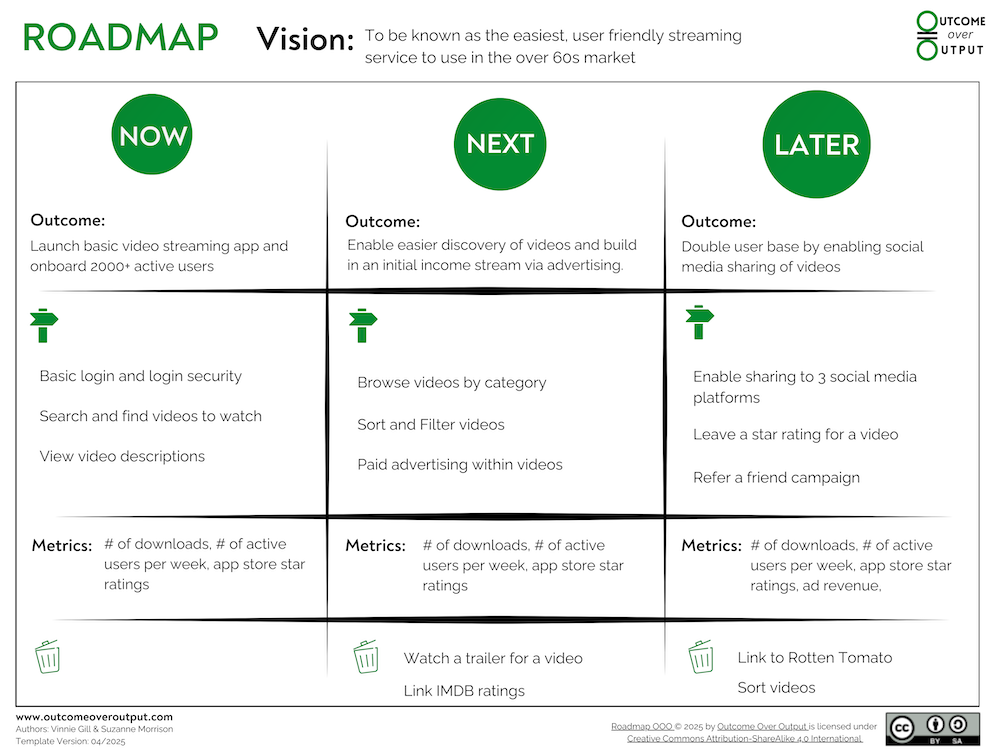
You can see an example of a product roadmap using the now, next later format below. This product roadmap example is for a fictitious video streaming product. For each time period you can clearly see the outcome, the key features and the metrics.
Showing Outcomes and Metrics on Your Roadmap
A roadmap shouldn’t be a list of features, it’s a plan to deliver value to your customers. That’s where defining outcomes and metrics comes in. Without outcomes and metrics, it’s very easy to fall into the trap of building stuff without actually knowing whether it’s adding value.
Here’s how to keep your roadmap outcome-focused and measurable:
 Start with the ‘Why’
Before you even think about features or deliverables, ask: What’s the problem we’re trying to solve?
Outcomes should reflect the positive change you want to create, whether it’s improving customer satisfaction, reducing churn, or increasing engagement.
A good outcome answers the question, “What will be different if we succeed?”
Keep Outcomes Customer-Focused
Outcomes aren’t about what you are building, they are about the value that customers experience. Try to frame outcomes around customer behaviours or needs, such as increasing adoption or improving usability.
What are NOT outcomes?
Here are some common items we see on roadmaps, masked as outcomes:
- procurement tasks
- research activities
- sign offs
- budget approvals
- development tasks
- features
If you find yourself listing out tasks like the ones above, ask the question “what will be different once these tasks are completed?” That will help you to articulate the outcome you are trying to achieve.
Define Clear Metrics
Once you’ve identified your outcomes, attach measurable metrics. These should be specific enough to track progress and validate whether you’re hitting the mark. Use metrics that are meaningful and easy to measure.
- Leading metrics: These give early indications of success, e.g. “Daily active users.”
- Lagging metrics: These confirm longer-term impact, e.g. “Customer retention rate.”

Not all metrics are created equal. Vanity metrics like counting total downloads or page views without context might look impressive but don’t really tell you if your product is delivering value. Focus on metrics tied to meaningful outcomes.
By defining outcomes and metrics on your roadmap, you move from “What are we building?” to “What value are we creating?” This not only drives better decision-making but also helps the whole team stay focused on what really matters, delivering outcomes, not just output.
Vision, Strategy, Roadmap, Plan and Backlog – What’s the Difference?
It’s easy to get mixed up with all the different artefacts – the vision, strategy, product roadmap, plan and product backlog. They’re often confused, but each serves a different purpose. The key is understanding how they fit together to guide your product’s journey.
The diagram below inspired by Roman Pichler from his book Strategize, illustrates how these artefacts connect. If you find yourself jumping straight into creating backlog items without first defining your vision and strategy, take a step back. Aligning on the bigger picture first will help you make better product decisions..
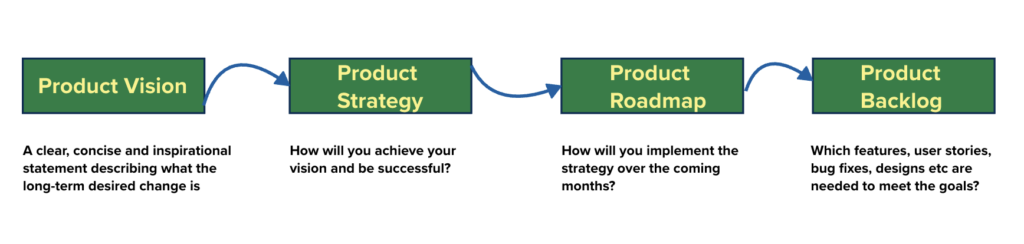
Product Vision: A short, 1 or 2 sentence statement that captures your long-term aspiration. It should be inspiring, memorable, and easy to understand – something that excites people about the future of your product.
Strategy: Defines the approach for achieving that vision and making your product successful. It provides direction and ensures everyone is working towards the same goals.
Product Roadmap: Translates strategy into a high-level plan, showing the key outcomes for the next 12 months or so. It helps align teams and stakeholders on where the product is headed.
Product Backlog: An ordered list of everything needed to improve the product over time, including items such as features, user stories, bug fixes, designs, investigations, and more. Unlike the roadmap, which is strategic, the backlog focuses on the detailed execution of work.
Roadmap vs Plan
We’ve all seen the common mistake of treating a roadmap like a detailed project plan, but a roadmap isn’t meant to be rigid. When facilitating, we encourage teams to start with something simple and refine as they go. It’s better to begin with something that’s not perfect and evolve it over time.
Key Differences:
- Plans:
- Exact Dates: Fixed timelines and deadlines.
- Work Breakdown Structure: Detailed decomposition of tasks.
- Task List: A comprehensive list of specific tasks, sometimes even with names assigned!
- Not Aligned with the Vision: Often too focused on immediate tasks, missing the bigger picture.
- Roadmaps:
- High-Level: Focuses on overarching goals and direction.
- Outcome-Focused: Centres on the results you want to achieve.
- Communication Tool: Aligns teams and stakeholders around the vision.
- Brings the Vision Alive: Translates strategic goals into a clear direction.
If your product roadmap feels more like a plan, it’s a good opportunity to realign.
Roadmap vs Backlog
Another common mix-up is between the product roadmap and the product backlog. They’re closely connected but serve different purposes.
Key Differences:
- Product Roadmap:
- Strategic: Focuses on the big picture – where the product is headed.
- Time-Based Categories: Organised by timeframes like Q1, Q2, or broader buckets like Now, Next, Later.
- High-Level: Highlights key outcomes, major features, and strategic opportunities.
- Vision-Driven: Guides decision-making and aligns the team with long-term goals.
- Product Backlog:
- Tactical: Focuses on the details needed to build the product.
- Granular: can includes user stories, tasks, defects, spikes, and epics
- Execution-Focused: Prioritises what needs to be done next to deliver value incrementally.
If you’re rushing into writing backlog items without a clear roadmap, it’s worth pausing. A solid roadmap ensures your backlog leads somewhere meaningful, keeping the team aligned with the bigger picture.
In a Nutshell:
- The Roadmap sets the strategic direction.
- The Plan maps out specific tasks and timelines.
- The Backlog is an ordered list of work items needed to build the product.
Understanding these differences helps teams stay focused, flexible, and aligned with their goals.

Facilitating a Product Roadmap Session
Creating a product roadmap isn’t a solo mission, at least, not if you want it to be successful. If you build it in isolation, you can expect things like:
- No one buying into the Product Roadmap
- Timescales that belong in a fantasy novel
- Misunderstandings
- Outcomes that are technically impossible
To avoid this, start by speaking to real customers. You need to understand their problems and needs.
Next, collaborate with the people who will actually be building the product, plus stakeholders, leadership, and subject matter experts. There are no shortcuts here, conversations lead to better roadmaps.
To create your first draft of the roadmap, start by listing all the outcomes you’d like to achieve. Then, stack rank them based on factors like value, effort, risk, and dependencies. Once ranked, discuss with your team where each outcome fits: Now, Next, or Later.
Another effective way to prioritise your work is through a User Story Mapping session (stay tuned for a deep dive on this in a future issue!). This technique helps you and your team visualise the customer’s journey and make informed decisions about which outcomes to focus on in the Now, Next, or Later stages.
Once you have your draft, gather your team for another collaborative session to get feedback on your draft roadmap.
- Share your roadmap
- Review your outcomes
- Review priorities and ensure they align with the product or company’s strategy
- Ask for feedback
- Delete what is not relevant
Remember, roadmaps aren’t carved in stone, they evolve as you learn, and that’s what makes them valuable.
Why Roadmaps Fail
Here are some of the most common reasons that roadmaps fail.
- Lack of Review: One of the biggest reasons roadmaps fail is the lack of scheduled review sessions. Without check-ins, it’s easy to lose sight of the direction. Allocating time for review sessions ensures you stay aligned with market changes, progress, and necessary adjustments.
- Where am I heading? Not keeping the vision in mind creates a disconnect. This can be not only confusing but creates misalignment. As Yogi Berra said “if you don’t know where you are going, you’ll end up somewhere else!” If you don’t have a vision, this is where you should start.
- Resistance to Change: A successful roadmap must be adaptable to change. As you move further into the future, uncertainty increases. As you release new features, you’ll learn what works and what doesn’t, which may lead to adjustments. External factors such as market shifts, customer needs, or new technologies can also prompt changes to your roadmap. Treat your roadmap as a living document that evolves based on feedback, data, and learnings from each release.
- Lack of co-creation: Roadmaps developed in isolation without input from key stakeholders and teams can lead to misalignment and lack of buy-in. Engaging with your team, stakeholders, customers, and leadership early makes it easier to secure buy-in, ensures nothing critical is overlooked, and prevents you from adding items that may not be technically feasible.
- Overwhelming Complexity: Roadmaps that try to include too much can become confusing, unmanageable, resembling an overwhelming pick-and-mix rather than a clear guide. Keep your roadmap simple, high level and easy to understand.
- The Customer, who? Roadmaps that aren’t regularly reviewed with customer feedback in mind risk becoming disconnected from actual needs and market demands. Without prioritising customer insights, roadmaps may fail to deliver the value expected.
- The Delete button is your friend: Teams often hesitate to remove items from the roadmap, even when they no longer fit. Being brave enough to say no or to hit delete is essential for staying relevant.
- Sharing is Caring: Don’t keep your roadmap to yourself, communicate, and share so that your teams feel a part and that they feel part of the journey.
Avoid these pitfalls by ensuring your roadmap stays alive. Just like navigating through waves, you need to adjust your direction to stay on course.
Next Steps for your Product Roadmap
Once you have your product roadmap, don’t make that mistake of letting it gather dust on your hard drive (or lost in the cloud).
Your roadmap shouldn’t be static, it needs regular check-ins to stay relevant. Schedule regular reviews with your team and stakeholders to assess progress and make updates. Remember to focus on outcomes, not just the completion of features.
Keep stakeholders and teams engaged by sharing regular updates, being transparent about any changes, and celebrating key wins. So that you can keep everyone aligned and motivated as you deliver on the roadmap.
Finally, stay flexible. As new information emerges, be prepared to revisit priorities and adjust the roadmap accordingly. Our template was created with this in mind – see the space for binning items you no longer need on our template.
If you are ready to get started co-creating your roadmap, remember that the key to most things is to make a start and don’t strive for perfectionism.
Make changes and improvements as you go and if you need any help feel free to reach out to us.
If you’re not already subscribed to our newsletter, subscribe below for free and receive a monthly product and delivery deep dive, and our product roadmap template.